

You’re stuck choosing between fabricated steel and concrete, staring at plans like they’re written in hieroglyphics, while the contractor swears both are “obviously best” and your budget whimpers in the corner.
Compare cost, speed, and durability using clear data from this authoritative report: Comparative Cost Study of Steel and Concrete Structures, then match the winner to your project’s needs.
• 🏗️ Structural Strength and Load-Bearing Capacity: Fabricated Steel vs Concrete
Fabricated steel and concrete both offer strong structural performance, but they behave differently under tension, compression, and dynamic loading. Choosing the right system depends on span, height, and use.
Steel components such as Galvanized fabricated steel bins and structural posts often deliver higher strength-to-weight ratios than traditional reinforced concrete.
1. Tensile and Compressive Strength Comparison
Steel has very high tensile strength and good compression resistance, while concrete excels mainly in compression and relies on rebar for tension.
- Steel: Handles both tension and compression efficiently.
- Concrete: Needs reinforcement to resist bending and cracking.
- Result: Steel suits long spans; concrete suits heavy gravity loads.
2. Strength-to-Weight Ratio and Dead Load
Fabricated steel frames are lighter than concrete frames with similar capacity, which reduces foundation loads and can lower substructure costs.
| Material | Relative Self-Weight | Typical Impact |
|---|---|---|
| Steel | Low | Smaller foundations |
| Concrete | High | Larger foundations |
3. Span Lengths and Column Spacing
Steel beams allow wider column spacing, which gives more open floor areas and better layout options for industrial and commercial projects.
- Longer spans reduce interior columns.
- Improved usable space and circulation.
- Ideal for warehouses and logistics hubs.
4. Performance Under Dynamic and Impact Loads
Steel frames respond well to dynamic loads from cranes, machinery, and wind, while concrete provides strong mass and damping for vibration control.
- Steel: More flexible, faster to recover after load.
- Concrete: Higher mass, better inherent damping.
• ⏱️ Construction Speed, Labor Requirements, and On-Site Assembly Efficiency
Fabricated steel structures often erect faster than cast-in-place concrete because most work happens off-site in controlled factory conditions.
This can reduce labor, shorten project schedules, and limit disruption on tight or busy sites.
1. Off-Site Fabrication vs On-Site Casting
Steel components arrive ready to assemble, while concrete needs formwork, rebar placement, and curing time on site.
- Steel: Precut, predrilled, and often pre-welded.
- Concrete: Weather-sensitive pouring and curing.
2. Labor Skill Levels and Crew Size
Steel erection uses smaller, specialized crews with cranes and bolting teams; concrete often demands larger general labor teams.
| System | Crew Size | Key Tasks |
|---|---|---|
| Steel | Medium | Lifting, bolting, welding |
| Concrete | High | Formwork, pouring, curing |
3. Schedule Comparison: Steel vs Concrete
Typical steel frames go up in days or weeks, while similar concrete frames may require longer cycles for each floor.
4. Site Constraints and Logistics
Steel offers an advantage on tight or urban sites because trucks deliver compact elements that cranes lift directly into place.
- Less storage space needed on site.
- Reduced wet trades and site waste.
• 💰 Lifecycle Cost, Maintenance Needs, and Long-Term Economic Performance
Initial cost is only one factor; owners must also consider maintenance, durability, and resale value when comparing fabricated steel with concrete.
A balanced cost analysis looks at the full building life, not just day-one spending.
1. Initial Construction Costs
Concrete can appear cheaper in materials, but steel may offset this with shorter schedules and lower labor, crane, and formwork costs.
| Item | Steel | Concrete |
|---|---|---|
| Material | Medium–High | Medium |
| Time-Related Costs | Lower | Higher |
2. Maintenance and Protection Over Time
Modern coatings and galvanizing greatly reduce steel maintenance, while concrete may need crack repair and protection against moisture and chemicals.
- Steel: Repainting intervals can be long.
- Concrete: Monitor for spalling and rebar corrosion.
3. Resale, Adaptation, and Demolition Value
Steel structures often have higher salvage and reuse value than concrete, which can improve long-term economic performance at end of life.
- Steel: Components can be unbolted and reused.
- Concrete: Usually broken and crushed as fill.
• 🌱 Environmental Impact, Material Recycling, and Sustainability Considerations
Both systems have environmental pros and cons, but fabricated steel can score well on recycling and material efficiency.
Design teams now weigh embodied carbon along with operational energy use.
1. Embodied Carbon in Production
Concrete uses energy-intensive cement, while steel production also has high emissions but benefits from large recycled content in many markets.
| Factor | Steel | Concrete |
|---|---|---|
| Recycled Content | High | Low–Medium |
| Mass per m² | Low | High |
2. Recyclability and End-of-Life Management
Steel is almost fully recyclable, often without loss of grade, while concrete is usually downcycled into aggregate.
- Steel: Closed-loop recycling stream.
- Concrete: Crushed for road base or fill.
3. Operational Sustainability and Insulation Strategies
Concrete’s thermal mass can stabilize indoor temperatures, while steel buildings rely more on high-quality insulation and detailing.
- Steel: Needs strong thermal breaks and cladding.
- Concrete: Slower temperature swings, good for some climates.
• 🔧 Design Flexibility, Seismic Performance, and Suitability for Complex Projects
Fabricated steel structures offer high flexibility, which helps on projects with irregular plans, large openings, or future expansion needs.
This adaptability often pairs well with modern industrial and infrastructure demands.
1. Architectural Freedom and Modifications
Steel frames allow slimmer members and easier changes to openings, mezzanines, and service routes during and after construction.
- Bolted connections ease later changes.
- Ideal for retrofits and expansions.
2. Seismic and Wind Performance
Steel frames perform well in earthquakes due to ductility, while concrete can provide stiff cores and shear walls for lateral resistance.
| Aspect | Steel | Concrete |
|---|---|---|
| Ductility | High | Medium |
| Stiffness | Medium | High |
3. Suitability for Industrial and Infrastructure Uses
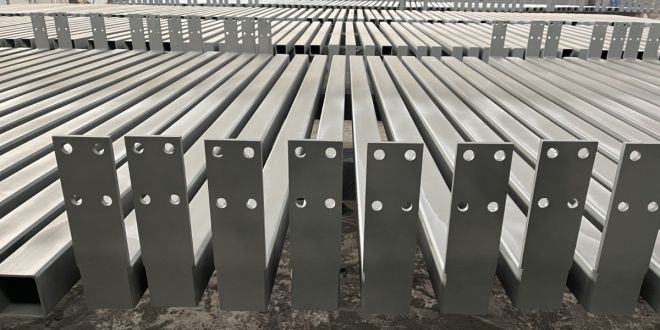
Fabricated components like Fabricated Fence Posts With Welded Base Plate and Square Tube Steel Post with Base Plate show how steel excels in repeatable, high-precision infrastructure and industrial settings.
- Consistent quality from factory production.
- Fast installation for fencing, supports, and frames.
Conclusion
Fabricated steel and concrete each deliver strong, safe, and durable structures. The best choice depends on project goals, budget, schedule, and performance needs.
Steel offers speed, flexibility, and recycling benefits. Concrete provides mass, stiffness, and robust fire resistance. Many modern projects combine both to balance cost and performance.
Frequently Asked Questions about fabricated steel structure
1. Is fabricated steel stronger than concrete?
Steel has higher tensile strength and a better strength-to-weight ratio than concrete. Concrete remains excellent in compression, so engineers often combine steel and concrete for optimal performance.
2. Are fabricated steel buildings safe in fire?
Yes, when designed correctly. Engineers protect steel with fireproof coatings, boards, or concrete encasement to meet required fire ratings and maintain structural stability.
3. How long can a fabricated steel structure last?
With good design, protective coatings, and routine inspections, fabricated steel structures can perform reliably for 50 years or more, often matching or exceeding concrete lifespans.
4. Is fabricated steel more expensive than concrete?
Material cost for steel may be higher, but faster erection and reduced labor can lower total project cost. A full lifecycle analysis often shows steel as competitive.
5. Can fabricated steel structures be extended or modified later?
Yes. Bolted connections and modular components make it easier to add bays, cut new openings, or reinforce members compared with many cast-in-place concrete systems.